
A mid the climate change anxieties that are on the increase and the fuel prices that are so unpleasantly high, the issue of electric cars versus gas cars is as heated as ever. Electric vehicles (EVs) are rapidly gaining more and more momentum on our roads, even though gas cars have been in control of our roads since the dawn of time. But how come the electric cars to be preferable to gas cars? Is it simply the case of being environmentally friendly or is there more behind the hood?
To respond to this, we are immersing ourselves in the advantages and disadvantages of the two, their characteristics, their effects on the environment, and finally guiding you to the conclusion regarding the type of vehicle that will make more sense in 2025 and the future.
Why Electric Cars Are Better Than Gas Cars
So, now we come to the burning question why are electric cars superior to gas cars? To start with, they do it more in support of the environment, as they do not leave any emissions during driving. This by itself is a game changer in the cities where air pollution is a genuine problem. Electric cars are also less expensive to run in daily basis. In a business where the cost of gas varies, electricity is generally less expensive and can be relied upon, and thus the cost of fuel can be lower.
Another huge victory of EVs is maintenance. The average electric car owner will incur significantly lower costs of regular services, as there are fewer components to wear out or break. And on the aspect of driving experience, EVs are quick yet almost instant, silent rides, and state-of-the-art technology. Numerous EVs are very much rolling computers that have huge infotainment screens, autopilot systems, and charging, climate, and lock systems that are controlled by an app.
In addition to individual gains, the governments worldwide are encouraging the purchase of electric cars. The benefits of going electric include tax credits, lower registration fees and carpool lanes among others. And we must still not overlook the future aspect of it all most nations and vehicle manufacturers are set to fill out the gas cars within the next 10-15 years. With an electric now, you are keeping ahead of the curve.
Features of Gas Cars
The standard over 100 years has been the gas-powered vehicles (also referred to as ICE Internal Combustion Engine vehicles).
Key Features of Gas Cars:
- Combustion engine: Burns fuel to generate power
- Fuel tank: Stores gasoline or diesel
- Transmission system: Usually automatic or manual
- Exhaust system: Releases gases after combustion
- Maintenance needs: Oil changes, filters, belts, etc.
- Instant refueling: 5–10 minutes at any gas station
- Long range: Typically 300–500 miles per tank
- Sound & Vibration: Traditional engine noise and feel
- Heavier carbon footprint
Gas vehicles come in all shapes and sizes—sports cars, SUVs, pickups, and compact sedans. They’re reliable, familiar, and have a well-established infrastructure.
Features of Electric Cars
Electric cars (EVs) abandon the gas and go the full electric. They are smooth, contemporary, and full of intelligent innovation.
Electric cars have the following special characteristics:
- Electric motor: Turns electricity to motion.
- Battery pack: Holds power ( normally lithium-ion)
- Regenerative braking: Dynamics during braking.
- One speed transmission: No changing of gears required.
- Home and public charge: plug and charge.
- Power: Rapid acceleration
- Importance of the engine: Quick turns in an instant.
- Silent operation: Silent driving virtually.
- Reduced maintenance: Reduced parts in motion.
- Software updates: As smartphones, only for your car.
EVs are the recent entrants and they are transforming the mode of thinking in transportation.
Why Do Some People Still Prefer Gas Cars?
We understand, not all people are prepared to go electric. There are drivers who still have inclination towards gas-powered vehicles. Here’s why:
- Better range of driving without having to pull up after hours.
- Shorter refueling time (5 minutes compared to 3060 minutes charging time).
- Lower upfront costs
- Presence of fuel stations all over.
- In severe cold (other EV batteries deteriorate) perform better.
- More towing & off-road options
- Coupled with recognizable sound and touch.
Being reasonable, however, gas cars are still appropriate to some lifestyles, particularly in rural places or in regions where EV charging is not as extensive as it should be.
Gas Cars vs Electric Cars Pros and Cons
Let’s break it down side by side:
| Category | Electric Cars | Gas Cars |
| Emissions | Zero while driving | High CO2 & NOx |
| Fuel Cost | Low (electricity) | High (gasoline) |
| Maintenance | Minimal | Frequent and costly |
| Acceleration | Instant torque | Delayed |
| Range | 250–400 miles | 300–500 miles |
| Refueling Time | 30 min – 8 hrs | 5–10 minutes |
| Sound | Quiet | Engine noise |
| Charging/Fueling | Home and public stations | Widespread gas stations |
| Initial Cost | Higher (but falling) | Generally lower |
| Eco-Friendliness | Very High | Low |
Environmental Impact of Gas vs Electric Cars
1. Gas Cars & The Environment:
- Produce CO2, methane, nitrogen oxides and PM.
- Key sources of air pollution and climate change.
- Relied on non-renewable fossil fuels.
- Ecosystems are also damaged during oil drilling and refining.
- Urban air quality is aggravated by tailpipe emissions.
The EPA estimates that an average gas-powered vehicle produces 4.6 metric ton CO2 per year.
2. Electric Cars & The Environment:
- Demonstrate zero tailpipe emissions.
- Reduced overall carbon footprint=even with unrenewable electricity.
- Going to be cleaner annually as power grids go renewable (solar, wind, hydro).
- None of the engine oil, spark plugs and exhaust emissions.
- There is a cost to battery production in the environment, however it is outweighed in the long run with savings in emissions.
According to a report by the International Energy Agency (2023), EVs can lead to a reduction of up to 70 percent in lifetime emissions in comparison to cars with ICE.
Life Cycle Emissions: EVs vs Gas Cars
Let’s look at emissions from manufacturing to disposal:
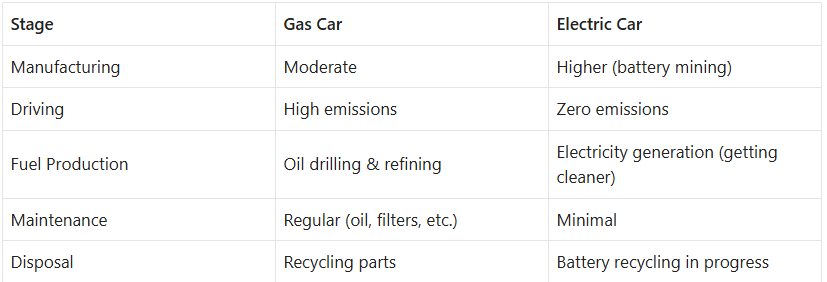
Conclusion: EVs win long-term in total emissions.
Are electric cars good to the environment?
Yes. EVs are not powered by coal electricity but even at that, they generate less CO2 in their lifetime as compared to gas cars.
What of the batteries, they are not good to the planet is they?
Battery mining is an environmental factor, which is getting better. And recycling initiatives and innovative battery technology are ensuring that they are greener.
Are electric cars able to drive in a rain, or a puddle?
Absolutely. EVs are completely covered and safe during rainy seasons.
Is it also expensive to have a home EV charger?
The simplest Level 2 charger system costs under 5 hundred to 1200 dollars and it would be possible to have rebates or tax credits too.
How often do you change the EV battery on average?
The battery of most EVs can have a lifespan of 10-15 years and has a warranty of 8 years/100,000 miles.
Conclusion
And what is the reason why electric cars are better than gas cars? To be brief, they are cleaner and less expensive to operate, and they have next-generation features that enhance the driving experience. They are more economical, more healthy and more environmentally friendly. Admittedly, gas cars have their merits, particularly regarding range and the speed of refueling, but it is becoming less and less significant with the further development of EV technology.
The decision would ultimately be in your needs and lifestyle and priorities. However, when you are seeking a future-proof, environmentally conscious vehicle, which is comparatively fun to drive, an electric car may be the dream you are seeking.